Awareness
Create trust, relevance, and emotional connection to the issue.
 Bharatiya Navchetana Foundation
Behavior, culture, and community transformation at institutional scale
Bharatiya Navchetana Foundation
Behavior, culture, and community transformation at institutional scale
6-Month Transformation Architecture
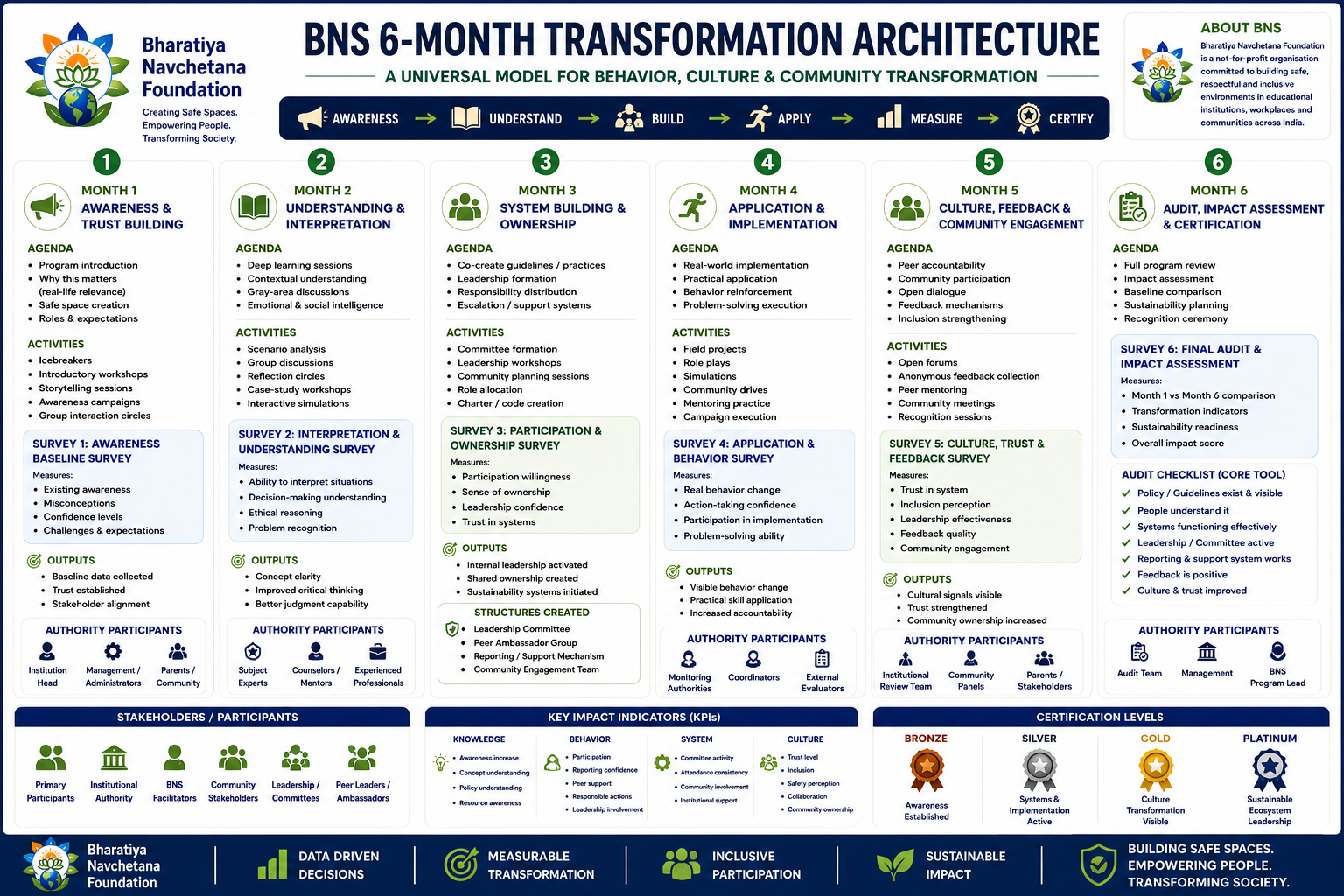
BNS uses a structured six-month architecture to move communities from awareness into understanding, ownership, application, feedback, audit, and sustainable change.
This architecture acts as the common backbone behind BNS programs in education, youth development, safe culture, environment, civic action, and digital safety.
Why This Framework Matters
The BNS architecture is designed for institutions and communities that want more than one-time orientation. It creates a visible pathway from awareness to policy understanding, system creation, practical action, and measurable review.
Because the structure is modular, the same backbone can be adapted for schools, colleges, corporates, communities, NGOs, and government-facing local programs without losing consistency in reporting or outcomes.
Framework Flow
Each stage is designed to create the conditions for the next one, so the program can move beyond learning into accountability and measurable institutional culture.
Create trust, relevance, and emotional connection to the issue.
Deepen interpretation, decision-making, and contextual clarity.
Create committees, support structures, and ownership systems.
Convert learning into visible action, implementation, and participation.
Strengthen habits, trust, inclusion, and peer accountability.
Review baseline-to-endline progress and prepare sustainability.
Transformation Architecture Poster
This poster presents the full architecture in one place so institutions, communities, and partners can understand the month-by-month structure without moving through separate journey cards.
Survey Architecture
Each month has a clear measurement lens so progress can be tracked across awareness, ownership, behavior, trust, and final impact.
Measure existing knowledge, attitudes, confidence, and initial perceptions.
Evaluate contextual understanding and ethical reasoning.
Measure engagement, system acceptance, and leadership confidence.
Assess real-life implementation, action confidence, and practical execution.
Measure trust, inclusion, leadership effectiveness, and community engagement.
Compare baseline to endline, validate transformation, and review sustainability readiness.
Impact Indicators
The architecture keeps reporting grounded in more than attendance by measuring knowledge, behavior, systems, and culture together.
Certification & Adaptability
The same architecture can be positioned differently by segment while preserving common review logic and certification.
Ready to Apply It?
If you want to position a new community, youth, safe culture, environment, or civic partnership program with greater clarity and credibility, this framework is the right foundation.